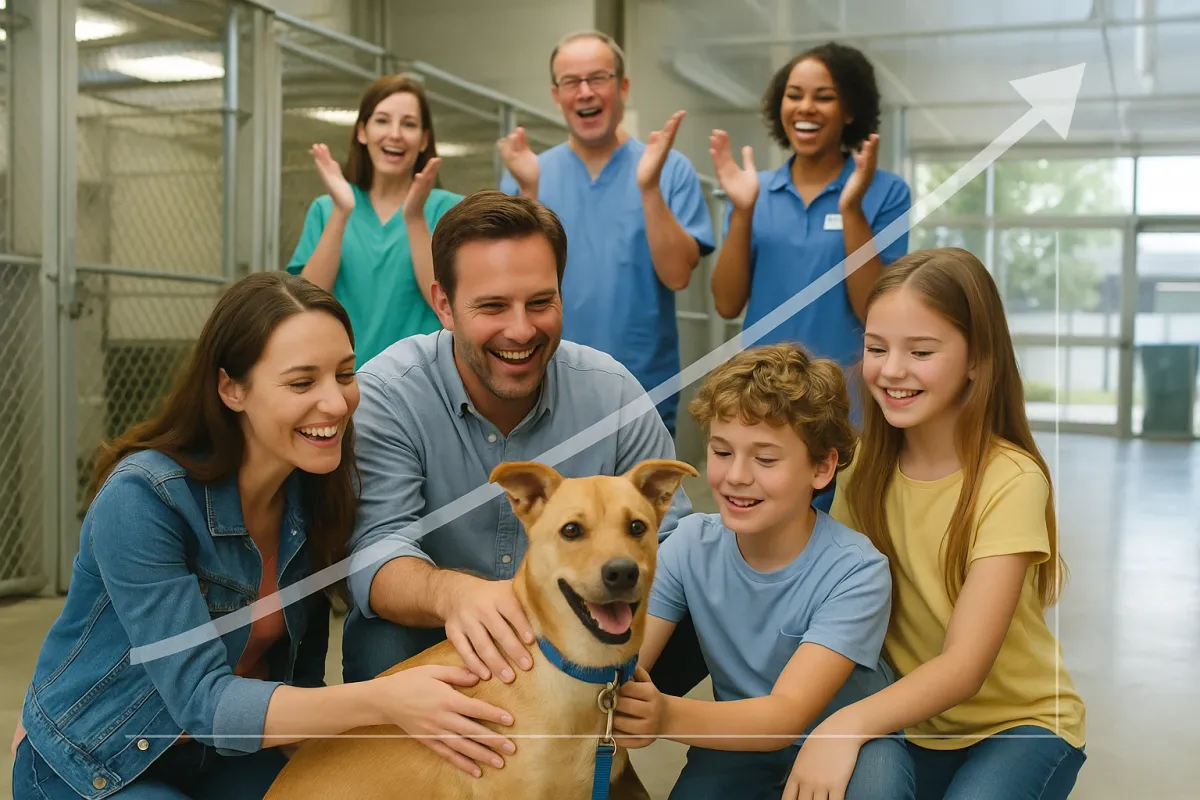
On the surface, a feel‑good adoption post has nothing to do with SaaS revenue. But the growth mechanics behind viral, mission‑driven content map remarkably well to high‑performing SaaS revenue engines: clear value narrative, strong retention loops, social proof at scale, and frictionless “adoption” (onboarding).
Below are five strategic, data‑driven lessons SaaS leaders can steal from the current surge in pet adoption content to optimize revenue and business growth right now.
Strategy 1: Build a “Furever Home” Product Experience to Reduce Revenue Churn
Pet adoption succeeds because people don’t just acquire an animal — they emotionally commit to a “furever home.” That’s retention by design. In SaaS, most teams obsess over acquisition channels while silently leaking ARR through preventable churn.
Benchmarks show median net revenue retention (NRR) for healthy B2B SaaS is 110–120%+, with top quartile climbing above 130%. If you’re below 100%, you’re effectively running on a treadmill: every new dollar is just replacing lost revenue. Translate the “furever home” mindset into product by designing for long‑term habit formation: clear “day 1” value, a fast path to first meaningful outcome, and recurring in‑product moments where users feel their progress. Instrument cohorts by signup month, measure 30/60/90‑day retention, and tie product usage depth (e.g., features adopted per account, workflows automated) to expansion potential. Your goal: make the cost — emotional, operational, and financial — of leaving your product obviously higher than staying, just as giving up a pet feels unthinkable. This mindset turns retention into a deliberate growth lever, not a lagging metric.
Strategy 2: Operationalize Social Proof the Way Adoption Stories Do
The pet adoption article wins because every story is a high‑affinity testimonial: before/after transformation, emotional payoff, visual proof. In the SaaS world, most “customer stories” are static PDFs no one reads. Yet data consistently shows social proof is one of the highest‑impact revenue drivers, especially in crowded categories.
To translate this into growth, think of every successful customer as a “micro‑story unit” that should be deployed across the entire funnel. Quantify impact: “Reduced onboarding time by 43%,” “Cut support tickets by 28%,” “Increased qualified pipeline by 32%.” Deploy these outcomes surgically — retargeting ads segmented by ICP, landing page variants by industry, in‑product nudges (“Teams like yours increased feature adoption by 21% using X”). Track click‑through rate, demo conversion, and opportunity win rate with and without social proof assets. Aim for at least 2–3 tailored proof points for your top three verticals. Like the pet adoption posts, your goal is to make the outcome so tangible that prospects feel irrational not to adopt your solution.
Strategy 3: Reduce Friction in Your “Adoption Funnel” Like a No‑Kill Shelter
Modern shelters understand conversion: they simplify paperwork, streamline approvals, and lower friction so the right animals get adopted faster. The November pet adoption surge is not accidental — it’s optimized. SaaS companies often do the opposite: bloated signup forms, vague pricing, and slow time‑to‑value suppress revenue long before sales ever touches the lead.
Treat your customer journey as an “adoption funnel” and instrument it end‑to‑end. Measure: visitor → signup, signup → activation (first key action), activation → PQL (product‑qualified lead), PQL → paid conversion. Identify step‑wise drop‑off and isolate friction: Is it unclear value messaging? Security concerns? Pricing anxiety? For PLG motions, a strong target is to get 30–40% of free signups to a defined activation event within 7 days, and convert 15–25% of PQLs to paid. Run A/B tests on onboarding flows, number of fields on signup, trial length, and in‑app prompts. Just as shelters remove barriers to a good match, you should be ruthlessly eliminating anything that slows a high‑intent user from becoming high‑value recurring revenue.
Strategy 4: Leverage Emotional Narrative to Command Premium Pricing
Pet adoption content performs because it’s not transactional — it’s narrative. “Dog adopted” is a transaction; “Senior dog finally finds a home after 300 days in the shelter” is a story people share and remember. The same dynamic governs SaaS pricing power. Products that are positioned purely as utilities invite comparison and discount pressure; products that are embedded in a larger narrative (“we power your entire revenue engine,” “we safeguard your customer trust”) support higher ACV and expansion potential.
The data is clear: companies that link their product to mission‑critical outcomes see higher close rates and larger deal sizes. In practice, this means moving beyond feature lists to a quantified “why now” storyline for each ICP: “Marketing teams drowning in manual reporting reclaim 20 hours per week,” “Revenue leaders cut forecasting error by 35% in two quarters.” Use this narrative in outbound, demos, and proposals. Track average contract value (ACV), discount rate, and sales cycle length before and after narrative refresh. When your pricing is backed by a compelling, data‑anchored story rather than a menu of features, you’re no longer negotiating the cost of software — you’re negotiating the value of a transformation. That’s how you escape the race to the bottom.
Strategy 5: Build Compounding Reach Through UGC and Community Flywheels
The Bored Panda adoption piece is a user‑generated content (UGC) engine: people submit their own pet photos and stories, the platform curates and amplifies, and each new cohort of stories brings new contributors. This is a compounding, not linear, growth system. Most SaaS companies still treat content and community as side projects instead of core revenue infrastructure.
To replicate this effect, architect a revenue‑adjacent community where your best users actively co‑create value: playbooks, templates, scripts, integrations, benchmarks. Give them structured ways to contribute (competitions, “customer spotlight” series, co‑hosted webinars), and build distribution paths where this content feeds your acquisition funnel: social clips, newsletter highlights, in‑product recommendations. Measure community‑sourced pipeline (opportunities where first touch came from community), community‑influenced win rate, and expansion for community members vs non‑members. A well‑run community program should eventually drive 10–30% of new qualified pipeline with a lower CAC than paid channels. Like a continuous stream of adoption stories, a healthy customer community keeps your brand top‑of‑mind, improves retention, and drives organic revenue growth long after paid campaigns end.
Conclusion
Today’s viral pet adoption stories aren’t just feel‑good content — they’re live case studies in modern growth mechanics: frictionless adoption, powerful narrative, visible outcomes, and compounding community effects. For SaaS leaders focused on revenue growth, the message is clear: you don’t need another generic “5 growth hacks.” You need a system that makes customers want to adopt your product, stay for the long haul, and proudly share their story.
If you treat every new account like a “furever” relationship, operationalize social proof, remove friction from your adoption funnel, elevate your narrative, and build community flywheels, your revenue curve starts to look a lot less like a leaky bucket — and a lot more like those November adoption charts: up, to the right, and powered by humans who are genuinely invested in what you’ve built.